IP67 vs IP68 – What Water Resistance Ratings Actually Mean
Your phone slips into the sink. Your stomach drops. Then you remember the IP68 rating on the box. You relax.
But should you?
Millions of people buy phones based on water resistance ratings without understanding what those numbers cover. The truth is more complicated than the marketing. This guide breaks down the IP67 vs IP68 debate, gives you real specs for popular phones, and tells you what to do when water gets in anyway.
What Is an IP Rating and Why Does It Exist?
IP stands for Ingress Protection. It is an international standard published by the International Electrotechnical Commission under the IEC 60529 specification. The rating tells you how well a device resists solid particles and liquid penetration under controlled test conditions.
Manufacturers submit devices to independent laboratories. The labs run standardized tests. The device passes or fails. That result appears on the box as both a marketing figure and a technical specification.
The Two Numbers on Every IP Rating Decoded
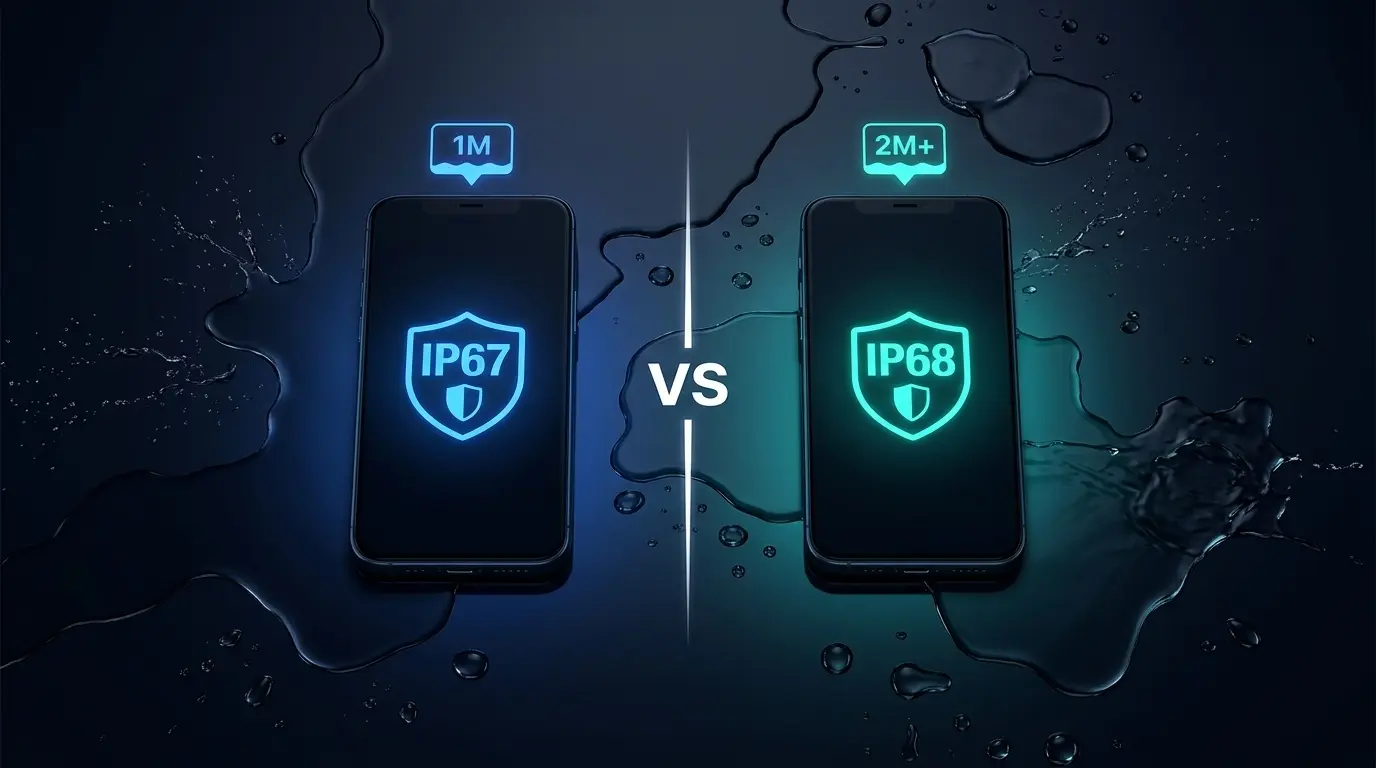
Every IP rating carries two digits. The first measures solid particle resistance. The second measures liquid resistance. A device rated IP67 scores 6 for dust and 7 for water. A device rated IP68 scores 6 for dust and 8 for water. That one digit difference is the entire debate.
What Does Each Digit Actually Tell You?
The first digit runs from 0 to 6. A score of 6 means completely sealed against dust particles during testing. Both IP67 and IP68 carry a 6 here. Dust protection is identical between the two ratings. It is never the deciding factor.
The second digit runs from 0 to 9. A 7 means the device survived submersion in 1 meter of fresh, still water for 30 minutes. An 8 means the device survived submersion beyond 1 meter for a duration the manufacturer defines. That manufacturer-defined clause is where the real difference lives.
IP67 Explained – What It Actually Covers
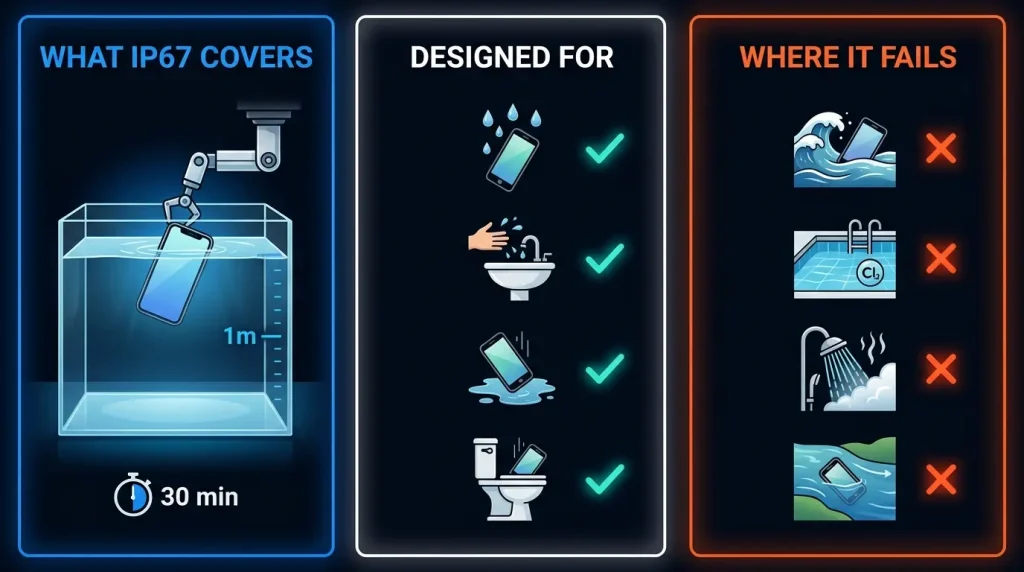
IP67 is a well-defined rating with no ambiguity. The IEC 60529 standard specifies that an IP67 device must survive submersion in 1 meter of fresh, still water for 30 minutes without harmful water ingress. The device is lowered gently. No current. No pressure applied.
This rating handles rain, light splashes, brief drops into puddles, and accidental toilet drops. It was designed for accidental submersion, not intentional water use.
Where IP67 falls short is anywhere beyond these narrow conditions. Moving water, chemicals, and heat all sit outside what the test measures.
IP68 Explained – Why the Rating Is Deliberately Vague
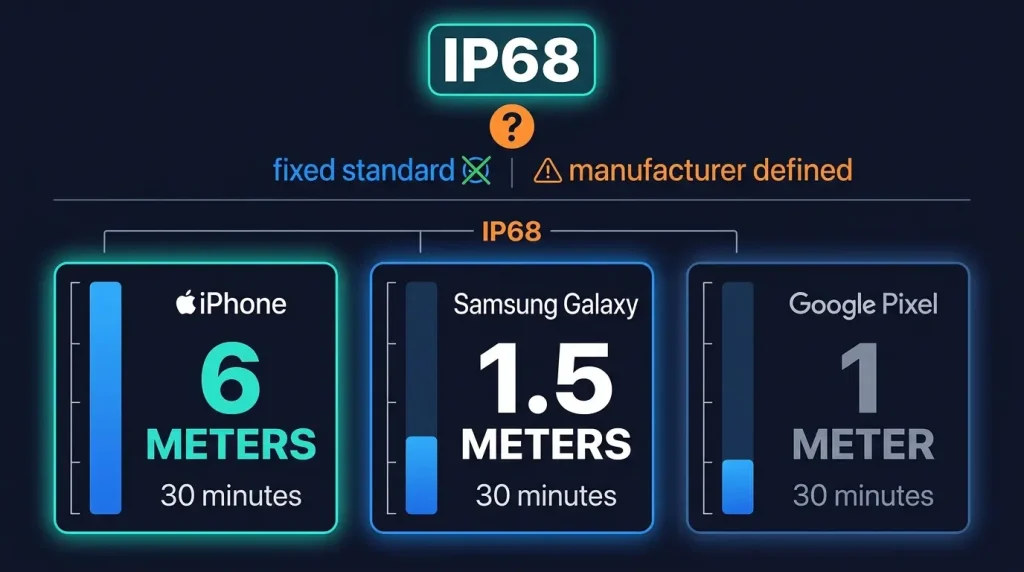
Unlike IP67, IP68 has no fixed depth or duration. The IEC 60529 specification states only that an IP68 device must survive submersion beyond 1 meter under conditions the manufacturer specifies.
Why Manufacturers Set Their Own IP68 Limits
Two phones carrying identical IP68 labels can have dramatically different real-world water resistance. Apple tests iPhone 16 Pro at 6 meters for 30 minutes. Samsung tests Galaxy S26 at 1.5 meters for 30 minutes. Google Pixel 9 is tested at 1 meter for 30 minutes. All three carry the same IP68 label. One handles four times more depth than another.
The label tells you nothing about which phone. Always check the manufacturer-published specification, not just the rating.
What IP68 Does Not Guarantee
IP68 does not mean waterproof. It does not mean the rating persists indefinitely. It does not mean performance outside the specific manufacturer-defined test. It does not mean your warranty covers water damage. Four separate truths the IP68 label leaves completely invisible.
IP67 vs IP68 – Direct Comparison
Specification | IP67 | IP68 |
|---|---|---|
Dust protection | Complete (6/6) | Complete (6/6) |
Water depth | 1 meter | Beyond 1 meter (manufacturer defined) |
Submersion time | 30 minutes | Manufacturer defined |
Water type tested | Fresh, still | Fresh, still |
Saltwater covered | No | No |
Warranty coverage | No | No |
IP67 covers everyday accidents for most people. IP68 matters when you regularly work near water or want additional depth tolerance. Verify the manufacturer-specific depth before assuming IP68 means 6 meters.
The Truth About Waterproof Phones Nobody Tells You
The word waterproof does not appear in the IEC 60529 standard. It is a marketing term with no technical definition. Every phone described as waterproof in advertising carries the more accurate label of water resistant in its technical documentation.
Lab Tests vs Real World Conditions
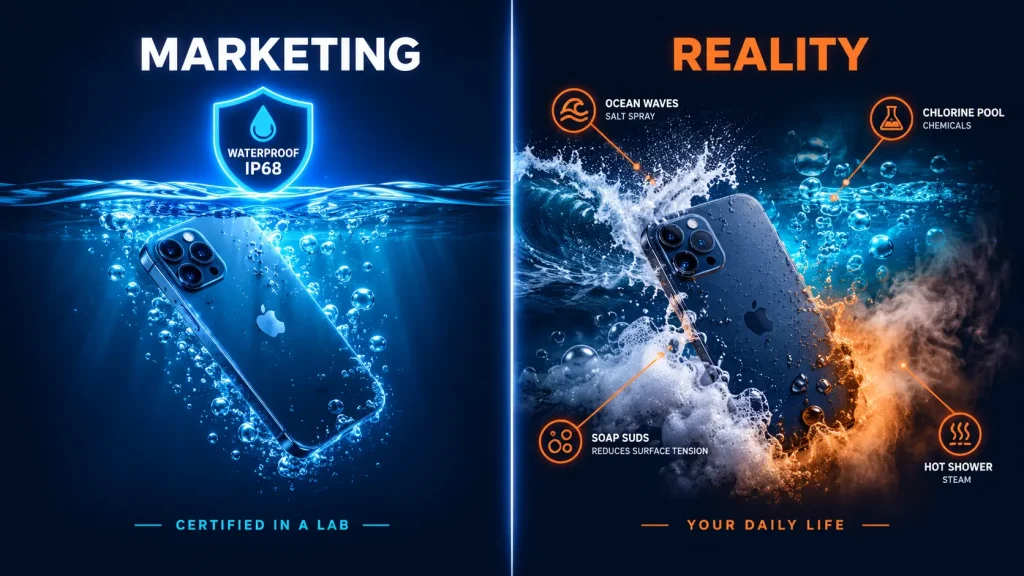
The official IP test uses fresh, still water at a controlled temperature. Your phone encounters rain under pressure, chlorinated pools, corrosive saltwater, and soapy showers. A 2023 Consumer Reports analysis found that phones passing IP68 certification showed measurable water ingress after saltwater exposure in independent testing. The IEC standard does not test real-world water sources because it was never designed to replicate them.
Why Saltwater, Chlorine and Soap Destroy Water Resistance
Saltwater corrodes the rubber seals that create the water barrier inside your phone. Chlorine in pools breaks down adhesive gaskets. Soap reduces water surface tension, allowing penetration through seals that fresh water would not breach. Steam from showers attacks seals with heat and pressure simultaneously. None of these conditions appear in the IP test environment.
How Drops Silently Kill Water Resistant Seals
The greatest threat to water resistance is impact, not water. Every time your phone hits a hard surface, the frame flexes slightly. That flex creates microscopic gaps in the seal. iFixit teardown analyses show visible seal degradation in most phones between 18 and 24 months of regular use. A phone that tested at IP68 when new may not meet IP67 standards after one year of drops and daily handling.
What Happens When Your IP68 Phone Gets Water Damaged?
It happens more than manufacturers admit. IP ratings are not guarantees.
Why Water Damage Happens Even on IP68 Phones
Water damage on IP-rated phones traces to three causes almost every time. Seals degraded from prior impact or age. The water source was not fresh water. Submersion exceeded the manufacturer-specified depth or duration. Apple’s liquid damage indicator turns pink or red when water contact occurs regardless of IP rating, and triggers a warranty exclusion automatically.
What to Do Immediately
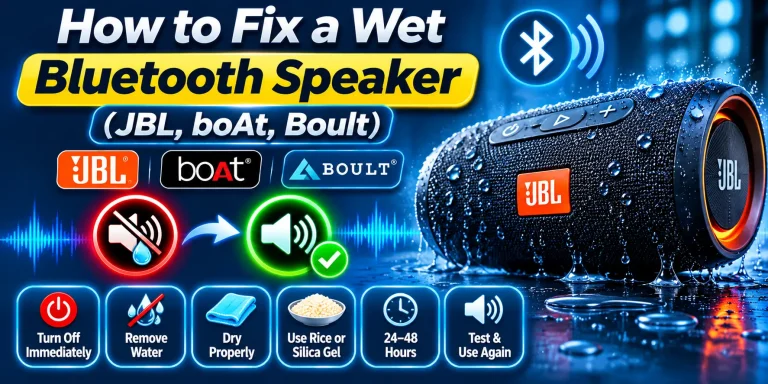
Turn the phone off. Remove the SIM tray. Pat the exterior gently with a dry cloth. Point ports downward. Do not use heat. Do not charge it. Skip the rice entirely. Rice is ineffective for internal moisture and introduces starch particles into speaker and port openings. Use silica gel packets in a sealed bag for 24 to 48 hours instead.
How to Fix a Wet Speaker on Any IP Rated Phone
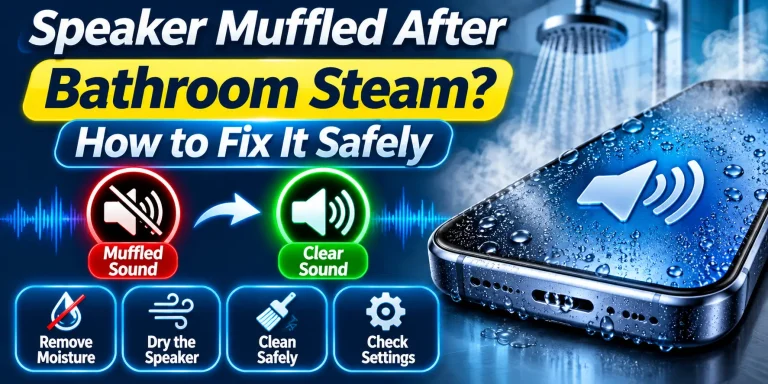
The speaker shows water damage symptoms first. Muffled audio, crackling, and silence after water exposure all indicate moisture inside the speaker mesh.
Use Phone Speaker Cleaner at fixmyspeakercleaner.net immediately. The tool plays a 165Hz frequency tone that vibrates the speaker diaphragm and pushes trapped water out through the mesh. This works on IP67 phones, IP68 phones, and any device regardless of rating. Point the speaker downward, set volume to maximum, and run the tool two to three times. This is the same acoustic ejection principle used in Apple Watch water eject mode.
Does Your Phone Warranty Cover Water Damage?
No. Every major manufacturer sells phones with IP68 ratings. Every major manufacturer excludes water damage from standard warranty coverage.
Apple’s standard warranty explicitly excludes damage caused by liquid contact. AppleCare Plus covers two accidental damage incidents per year including liquid damage for a service fee. Without it, water-damaged iPhone repairs cost between 229 and 599 dollars depending on model.
Samsung’s warranty mirrors Apple’s position. Water damage is excluded regardless of IP rating. Samsung Care Plus offers accidental damage protection for a monthly fee. Without coverage, Galaxy S series water damage repairs typically cost 200 to 500 dollars.
The IP rating is a certified test result. It is not a performance promise. You are buying water resistance as a feature, not as a guarantee.
IP Ratings on Popular Phones in 2026
iPhone Models
iPhone 17 Pro Max, Pro, Plus, and standard: IP68 at 6 meters for 30 minutes.
iPhone SE 3rd generation: IP67 at 1 meter for 30 minutes.
Samsung Galaxy Models
Galaxy S26 Ultra and S26: IP68 at 1.5 meters for 30 minutes.
Galaxy A55: IP67 at 1 meter for 30 minutes.
Google Pixel Models
Pixel 9 Pro and standard: IP68 at 1 meter for 30 minutes.
Pixel 8a: IP67 at 1 meter for 30 minutes.
Common Myths About IP Ratings
Swimming With an IP68 Phone Is Safe
It is not. Pool chlorine and ocean salt both exceed what IP testing covers. Moving water creates pressure beyond static submersion test parameters. Swimming with any phone risks water damage regardless of the rating.
Higher IP Number Always Means Better Overall Protection
Not in every scenario. IP66 handles powerful water jets better than IP67 in some conditions. The second digit describes a specific test type, not universal water resistance superiority.
IP Ratings Last Forever
They do not. Seals degrade from heat, cold, UV exposure, and mechanical stress. There is no consumer-accessible way to verify current water resistance without laboratory testing.
How to Keep Your Phone Water Resistant Longer
Use a case that absorbs drop impact. Impact is the primary cause of seal failure. A case preventing frame deformation preserves the seals that create water resistance.
Avoid saltwater, chlorinated water, and soapy water regardless of depth rating. Run the speaker ejection tool at fixmyspeakercleaner.net after any water exposure before charging or turning the device back on. Keep ports dry and never charge a wet phone regardless of IP rating.
Frequently Asked Questions
Final Word
IP67 vs IP68 is a real difference. One is a fixed standard. The other lets manufacturers define their own terms. Both describe controlled laboratory conditions your daily life will never replicate.
The number on the box means the device passed a specific test. It does not mean waterproof. It does not mean warranty coverage. It does not mean the seals hold after 18 months of drops and daily wear.
Use the rating as a safety net for accidents, not as permission to take your phone swimming.
If water reaches your speaker, act immediately at fixmyspeakercleaner.net. Two minutes with the 165Hz ejection tool prevents the corrosion that turns a recoverable accident into permanent damage.